
Kazakhstan Is Ageing: The Elderly Population Is Growing Significantly Faster Than the Number of Children
27 April 2026
 1027
1027
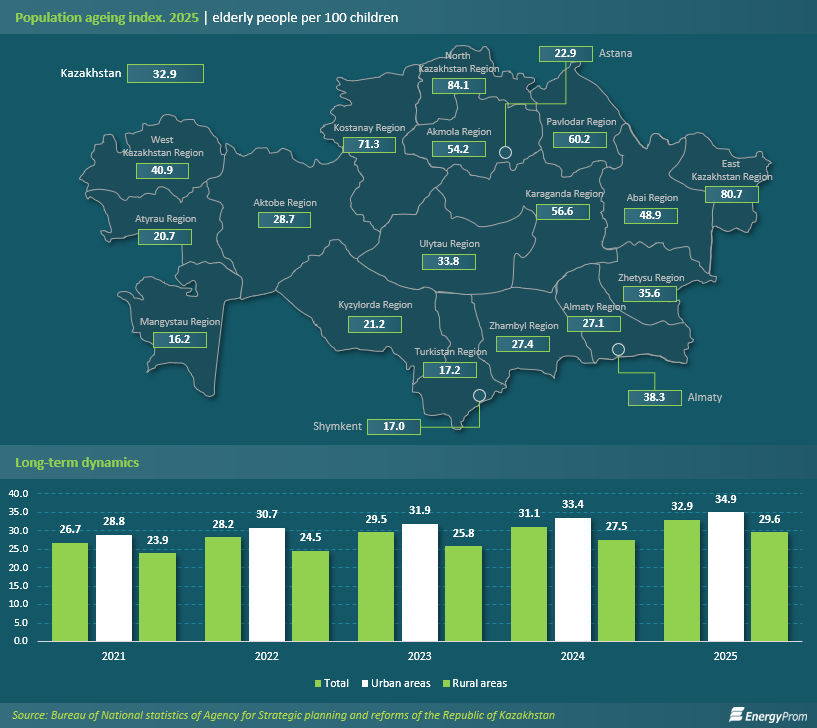
Population ageing in Kazakhstan continues to accelerate. The ageing index, which shows how many elderly people account for every 100 children, has been steadily increasing in recent years. While the indicator stood at 26.7 in 2021, by 2025 it had reached 32.9. This means that there were already almost 33 elderly people per 100 children under the age of 15 in the country. In effect, the indicator has risen markedly over the past four years, and the trend remains устойчивым.
Urban populations are ageing particularly rapidly. In 2025, the urban population ageing index reached 34.9, compared to 28.8 in 2021. The situation in rural areas is somewhat less severe, although the upward trend is also evident there: the indicator increased from 23.9 to 29.6. This suggests that the demographic gap between generations is narrowing across the country.
The regional picture appeared even more alarming. In a number of regions, Kazakhstan has effectively already entered a phase of pronounced population ageing. The highest indicators were recorded in North Kazakhstan Region (84.1), East Kazakhstan Region (80.7), and Kostanay Region (71.3). In these regions, the number of elderly residents could soon approach the number of children. Karaganda Region (56.6), Pavlodar Region (60.2), and Akmola Region (54.2) also demonstrate an extremely unfavourable population structure.
At the other end of the spectrum remain the southern and oil-producing regions, where demographics are comparatively younger — Mangystau Region (16.2), Turkistan Region (17.2), Shymkent (17), and Atyrau Region (20.7). However, even there the indicators continue to rise gradually, albeit from a lower base, and are unable to reverse the country’s overall negative demographic trend.
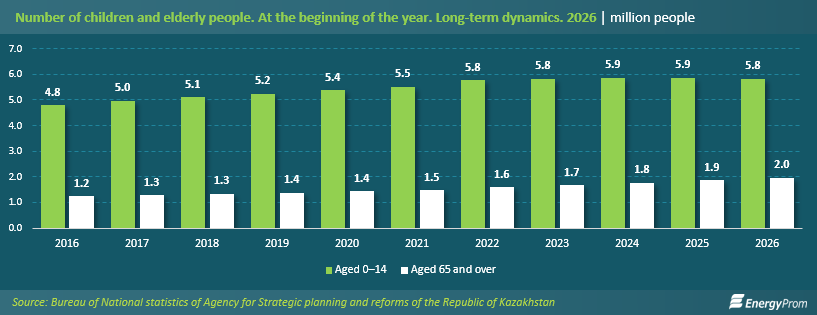
The key reason behind this trend is the worsening balance between birth rates and population ageing. Despite overall population growth, the demographic structure is shifting away from younger age groups. After a period of growth, the number of children under the age of 14 has effectively stabilised and has even begun to decline: from 5.9 million people at the beginning of 2024 and 2025 to 5.8 million at the beginning of 2026. Overall, the number of children increased by 21.5% over the past decade.
At the same time, the number of elderly Kazakhstan residents aged 65 and over has been steadily increasing, rising from 1.2 million people at the beginning of 2016 to 2 million at the beginning of 2026. Over the decade, the elderly population in the country grew by as much as 59.6% — significantly faster than the number of children.
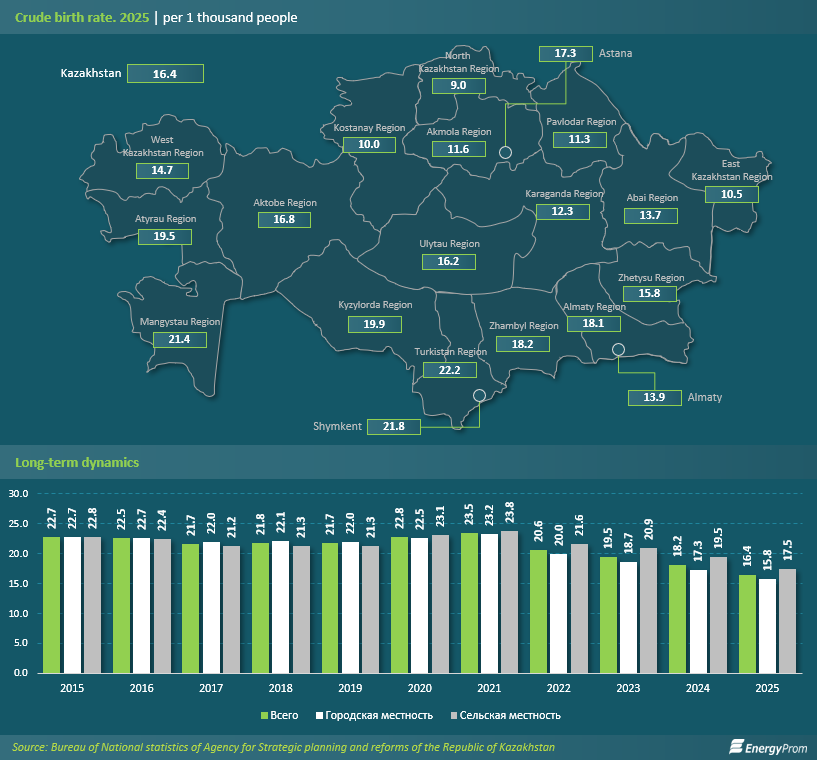
Additional pressure is being created by declining birth rates. In 2025, the crude birth rate fell to 16.4 per 1 thousand people. This represents a sharp, though expected, decline compared to the post-pandemic level of 23.5 recorded in 2021. In just four years, the birth rate in the country has fallen by almost a third. In urban areas, the birth rate dropped from 23.2 in 2021 to 15.8 in 2025, while in rural areas it declined from 23.8 to 17.5. Regionally, the lowest birth rates in 2025 were recorded in North Kazakhstan Region (9 per 1 thousand people), Kostanay Region (10), and East Kazakhstan Region (10.5).
Even in regions traditionally characterised by high birth rates, such as Turkistan Region (22.2) and Mangystau Region (21.4), growth has been gradually slowing. This means that the demographic “safety cushion” the country previously relied on is steadily weakening.
Population growth alone is no longer enough to resolve the issue. The population is increasing, but the share of elderly people within it is growing as well. As a result, the balance is shifting: the burden on the working population is rising, while the future labour force is shrinking.
The current trends are likely to persist, as this is a global pattern and a natural manifestation of demographic transition. Pressure on the labour market, healthcare system, and social welfare sector will continue to intensify. The longer solutions aimed at adapting society to this new reality are delayed, the more difficult and costly it will become to address the situation.


Which Social Networks and Messengers Do Kazakhstan’s Young People Prefer?
9 October 2025
17880
Kazakhstan’s Citizens Are Meat Lovers: Meat and Meat Product Consumption Up by 2%
29 October 2025
10210
Gas Production Declined, While Prices Jumped 28% Year-on-Year
17 September 2025
7875
Which Social Networks and Messengers Do Kazakhstan’s Young People Prefer?
9 October 2025
17880
Kazakhstan’s Citizens Are Meat Lovers: Meat and Meat Product Consumption Up by 2%
29 October 2025
10210
Gas Production Declined, While Prices Jumped 28% Year-on-Year
17 September 2025
7875
Popular articles
Watch all

Which Social Networks and Messengers Do Kazakhstan’s Young People Prefer?
According to the analytical report “Youth of Kazakhstan” for 2024, one of the most common ways young people spend their Читать далее...
9 October 2025
17880
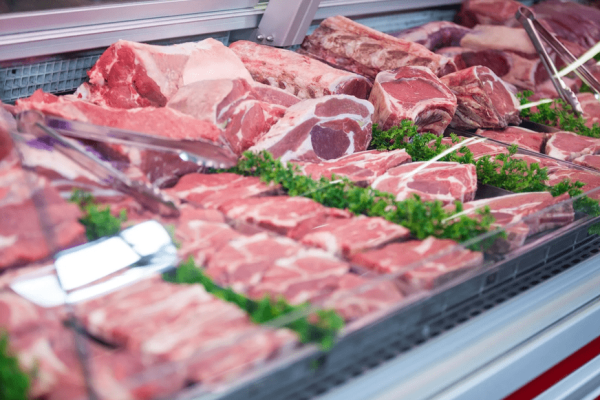
Kazakhstan’s Citizens Are Meat Lovers: Meat and Meat Product Consumption Up by 2%
In January–September of the current year, Kazakhstan produced 57.3 thousand tonnes of fresh or chilled meat from cattle, pigs, sheep, Читать далее...
29 October 2025
10210

Global Peace Index: The Number of Conflicts Is Rising, and the World Is Becoming More Dangerous
According to the annual Global Peace Index (GPI) published by the Institute for Economics & Peace, Iceland has remained the Читать далее...
12 January 2026
8605

Gas Production Declined, While Prices Jumped 28% Year-on-Year
In January–July of this year, natural gas production in Kazakhstan amounted to 14.8 billion cubic meters, down 10.3% compared with Читать далее...
17 September 2025
7875

Electric Vehicles Accounted for Less Than 1% of All Registered Cars in Kazakhstan
From January to July of this year, 925.8 thousand passenger cars were registered in Kazakhstan, 0.3% more than in the Читать далее...
28 August 2025
5591

“Pirating” in Kazakhstan: 59% of Young People Use Free Platforms to Watch Films and Series
According to the analytical report Youth of Kazakhstan for 2024, one of the most common leisure activities among young people Читать далее...
26 September 2025
5192
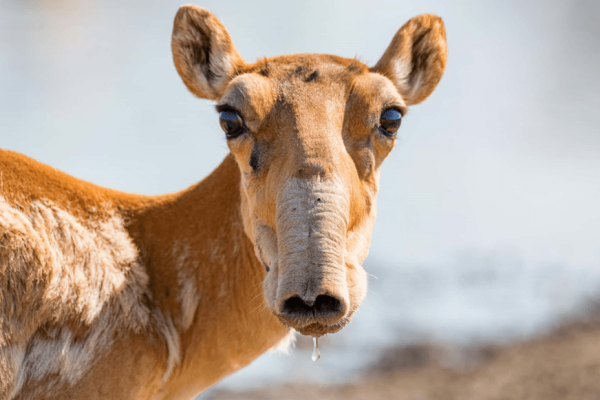
Who and why does Kazakhstan’s saiga antelope give trouble?
Experts question the department’s statistics, as well as decisions made at state level regarding saigas In early summer, there Читать далее...
28 June 2022
4827

Mobile Internet in Kazakhstan Keeps Getting Worse: Country Drops Six Places in Global Ranking
According to Ookla, the global median mobile internet speed stood at 113.16 Mbps in May 2026. The UAE topped the Читать далее...
16 July 2026
3664

Power generation reaches 53.7bn kWh in January-July, up by 1.7% year on year. Gas turbine power plants with a capacity of 100,000 kW worth KZT18.6bn were commissioned in the first half of the year
Electricity tariffs went up by 5.8% year on year in August
16 September 2016
2992

Kazakh oil refineries supplied 73.3% of motor fuel consumed and 97.4% of diesel fuel consumed in the country. Petrol output increased by 10.6% and production of gasoils by 3.6%
The price of the most popular octane-93 petrol increased by 16.4% year on year to KZT125 per litre in July. The price of summer diesel increased by 3.3% year on year to KZT99 per litre
15 September 2016
2937

How Much Do People in Kazakhstan Spend on Medicines?
In the second quarter of this year, household healthcare spending in Kazakhstan averaged 28.8 thousand tenge per household, 6.6% less Читать далее...
25 September 2025
2520

Kazakhstan’s Antibiotics Market Is Two-Thirds Dependent on Imports, While the Vitamins Market Is Almost Entirely Import-Dependent
Pharmaceutical production in Kazakhstan has increased significantly. In January–May 2026, output of basic pharmaceutical products and preparations reached KZT 109.5 Читать далее...
2 July 2026
2294

Three-Quarters of Kazakhstan’s Tea and Coffee Market Are Driven by Imports
Production of processed tea and coffee in Kazakhstan totaled 20.5 thousand tonnes in January–December of last year, up 18% compared Читать далее...
12 March 2026
2230

Focus on ESG: the world is confidently switching to green rails and sustainable development principles
In Kazakhstan, only some of the major backbone companies, major market players, and national development institutions are ready to implement Читать далее...
5 November 2021
2117

Industrial enterprises navigate to sustainable development
Major industrial companies’ investments into social and infrastructure projects in 2019 exceeded 140 billion Tenge Kazakhstan has been holding Читать далее...
5 November 2021
2034