
Three-Quarters of Kazakhstan’s Tea and Coffee Market Are Driven by Imports
12 March 2026
 201
201

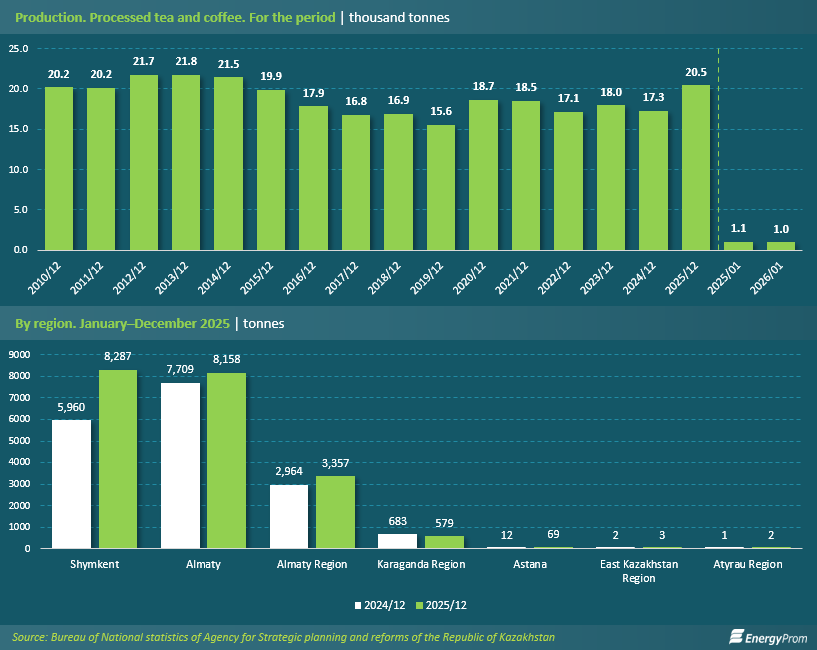
Production of processed tea and coffee in Kazakhstan totaled 20.5 thousand tonnes in January–December of last year, up 18% compared with the same period of 2024 (17.3 thousand tonnes). The sector reached a multi-year peak: the current figure is the highest since 2014, when output stood at 21.5 thousand tonnes. Following a prolonged period of stagnation in 2016–2019, when volumes fell to 15.6 thousand tonnes, the industry is demonstrating a steady recovery. However, the beginning of 2026 was marked by a slowdown in momentum: in January, less than 1 thousand tonnes of tea and coffee were produced, down 8% year-on-year.
Production activity is notably concentrated in a few regions. Shymkent led output, producing 8.3 thousand tonnes of tea and coffee in 2025, compared with 6 thousand tonnes a year earlier (plus 39%). Almaty ranked second with 8.2 thousand tonnes (year-on-year growth of 5.8%). Almaty Region closed the top three with 3.4 thousand tonnes (plus 13.3%). Together, these three regions accounted for 97.1% of total national output. Additional contributions came from Karaganda Region (579 tonnes) and Astana (69 tonnes).
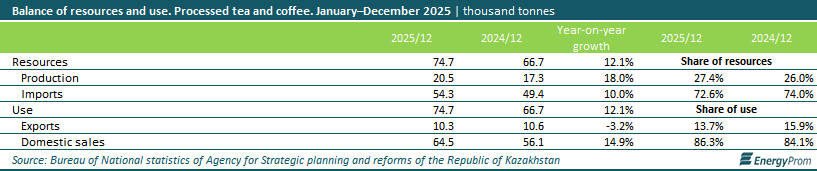
Despite the domestic industrial upturn, the market remains import-dependent. The share of imports in total resources amounted to 72.6% in January–December 2025, while import volumes increased by 10%, reaching 54.3 thousand tonnes. Nevertheless, the position of Kazakhstan’s producers is gradually strengthening: the share of domestic production in meeting demand (domestic sales plus exports) rose from 26% in 2024 to 27.4% in 2025.
Domestic sales grew by 14.9%, reaching 64.5 thousand tonnes, while exports declined by 3.2% to 10.3 thousand tonnes.
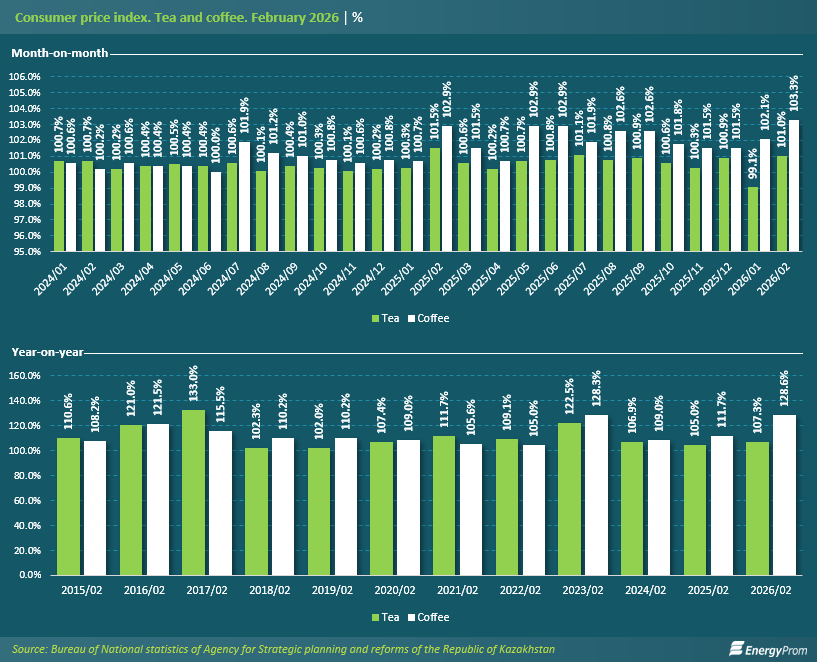
Prices in the sector are showing strong growth. In February 2026 alone, coffee prices increased by 3.3%, while tea rose by 1%. Moreover, unlike tea, coffee prices have been rising for 20 consecutive months, with no declines observed over the past 28 months.
On an annual basis, the increase in coffee prices reached a critical level, surging by 28.6%. For comparison, a year earlier the increase stood at 11.7%. Tea prices rose by 7.3% year-on-year (versus 5% a year earlier). Black tea prices increased by 7%, while green tea rose sharply by 11.2%.
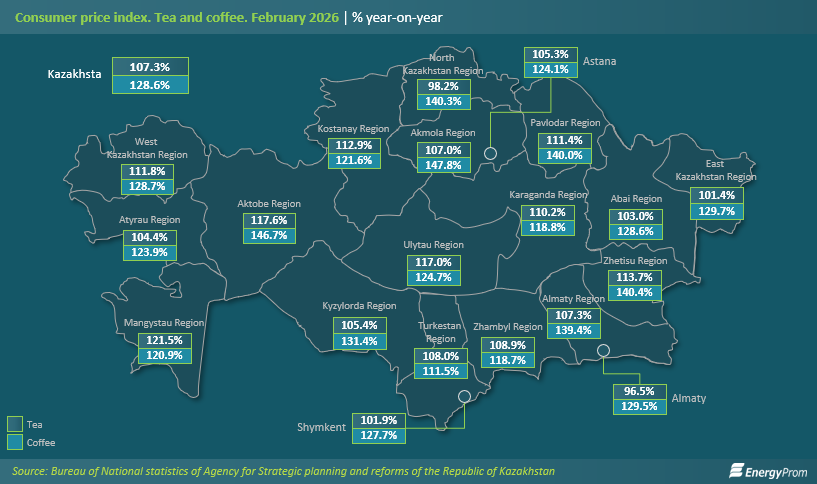
Regionally, the highest annual increases in coffee prices were recorded in Akmola Region (plus 47.8%), Aktobe Region (plus 46.7%), Zhetisu Region (plus 40.4%), North Kazakhstan Region (plus 40.3%), and Pavlodar Region (plus 40%). Prices increased in all regions. The smallest increase was observed in Turkestan Region (still a notable plus 11.5%), followed by Zhambyl Region (plus 18.7%) and Karaganda Region (plus 18.8%).
In the tea segment, price increases affected 18 out of 20 regions. The highest growth was recorded in Mangystau Region (plus 21.5%), Ulytau Region (plus 17%), and Aktobe Region (plus 17.6%). The smallest increases among regions with positive dynamics were observed in East Kazakhstan Region (plus 1.4%), Shymkent (plus 1.9%), and Abai Region (plus 3%). At the same time, tea prices declined year-on-year in Almaty (minus 3.5%) and North Kazakhstan Region (minus 1.8%).


Which Social Networks and Messengers Do Kazakhstan’s Young People Prefer?
9 October 2025
5980
Gas Production Declined, While Prices Jumped 28% Year-on-Year
17 September 2025
4792
Kazakhstan’s Citizens Are Meat Lovers: Meat and Meat Product Consumption Up by 2%
29 October 2025
4640
Who and why does Kazakhstan’s saiga antelope give trouble?
28 June 2022
3763
Which Social Networks and Messengers Do Kazakhstan’s Young People Prefer?
9 October 2025
5980
Gas Production Declined, While Prices Jumped 28% Year-on-Year
17 September 2025
4792
Kazakhstan’s Citizens Are Meat Lovers: Meat and Meat Product Consumption Up by 2%
29 October 2025
4640
Who and why does Kazakhstan’s saiga antelope give trouble?
28 June 2022
3763
Popular articles
Watch all

Which Social Networks and Messengers Do Kazakhstan’s Young People Prefer?
According to the analytical report “Youth of Kazakhstan” for 2024, one of the most common ways young people spend their Читать далее...
9 October 2025
5980

Gas Production Declined, While Prices Jumped 28% Year-on-Year
In January–July of this year, natural gas production in Kazakhstan amounted to 14.8 billion cubic meters, down 10.3% compared with Читать далее...
17 September 2025
4792
Kazakhstan’s Citizens Are Meat Lovers: Meat and Meat Product Consumption Up by 2%
In January–September of the current year, Kazakhstan produced 57.3 thousand tonnes of fresh or chilled meat from cattle, pigs, sheep, Читать далее...
29 October 2025
4640
Who and why does Kazakhstan’s saiga antelope give trouble?
Experts question the department’s statistics, as well as decisions made at state level regarding saigas In early summer, there Читать далее...
28 June 2022
3763

Electric Vehicles Accounted for Less Than 1% of All Registered Cars in Kazakhstan
From January to July of this year, 925.8 thousand passenger cars were registered in Kazakhstan, 0.3% more than in the Читать далее...
28 August 2025
3265

“Pirating” in Kazakhstan: 59% of Young People Use Free Platforms to Watch Films and Series
According to the analytical report Youth of Kazakhstan for 2024, one of the most common leisure activities among young people Читать далее...
26 September 2025
3069

Power generation reaches 53.7bn kWh in January-July, up by 1.7% year on year. Gas turbine power plants with a capacity of 100,000 kW worth KZT18.6bn were commissioned in the first half of the year
Electricity tariffs went up by 5.8% year on year in August
16 September 2016
2301

Global Peace Index: The Number of Conflicts Is Rising, and the World Is Becoming More Dangerous
According to the annual Global Peace Index (GPI) published by the Institute for Economics & Peace, Iceland has remained the Читать далее...
12 January 2026
2242

Kazakh oil refineries supplied 73.3% of motor fuel consumed and 97.4% of diesel fuel consumed in the country. Petrol output increased by 10.6% and production of gasoils by 3.6%
The price of the most popular octane-93 petrol increased by 16.4% year on year to KZT125 per litre in July. The price of summer diesel increased by 3.3% year on year to KZT99 per litre
15 September 2016
2103

How Much Do People in Kazakhstan Spend on Medicines?
In the second quarter of this year, household healthcare spending in Kazakhstan averaged 28.8 thousand tenge per household, 6.6% less Читать далее...
25 September 2025
1562

Safeguarding the nature: investment into environmental protection increased by 34% over the year
The number of fixed point sources of pollution in 10 years has increased by 58% Environmental issues are extremely Читать далее...
5 November 2021
1536

Industrial enterprises navigate to sustainable development
Major industrial companies’ investments into social and infrastructure projects in 2019 exceeded 140 billion Tenge Kazakhstan has been holding Читать далее...
5 November 2021
1498

Focus on ESG: the world is confidently switching to green rails and sustainable development principles
In Kazakhstan, only some of the major backbone companies, major market players, and national development institutions are ready to implement Читать далее...
5 November 2021
1413

Output of unrefined and semi-refined gold increased by 21.5% year on year, that of refined gold by 16.5%
Jewellery prices jump by 20.1% year on year on average in Kazakhstan, by 50% in Astana
6 September 2016
1310

Renewable energy generation capacities goes up by 40% year-on-year in Kazakhstan in 1Q2016
Clean energy generation jumps by 130% year-on-year in this period
22 June 2016
1192