
Women Earn Just 77% of Men’s Wages in Kazakhstan
13 April 2026
 1418
1418

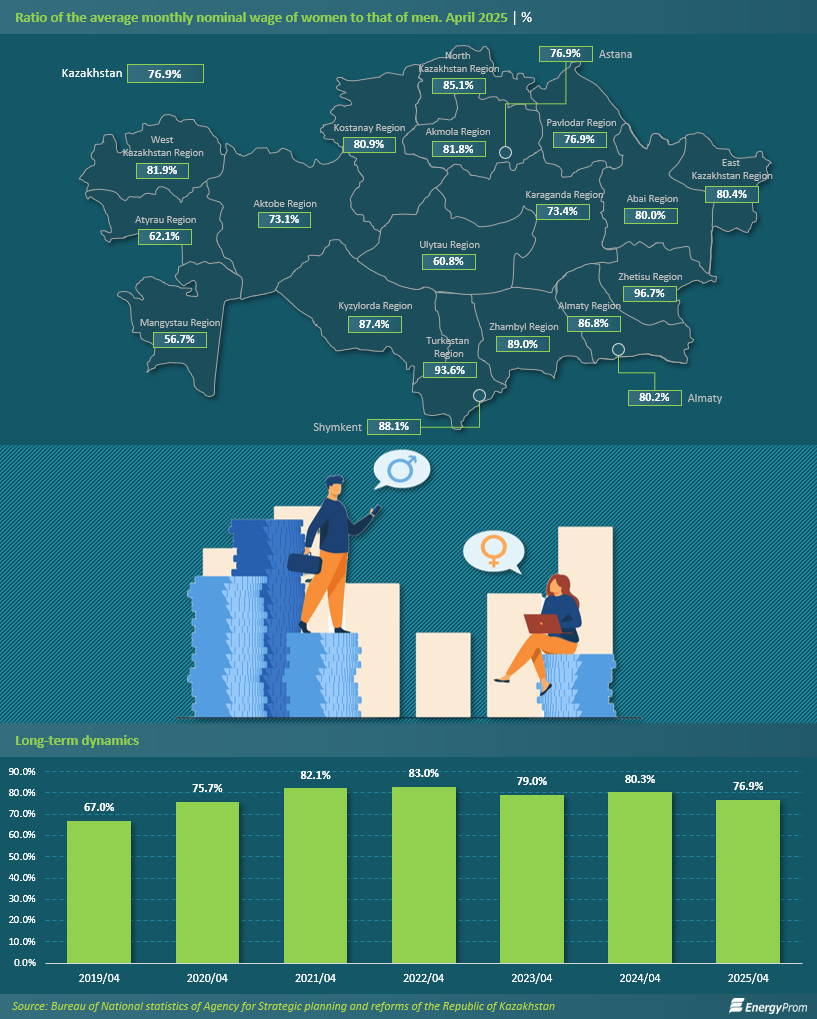
The gender pay gap in Kazakhstan remains persistent and significant, despite periods of partial improvement. As of April last year, the average monthly nominal wage of women amounted to only 76.9% of that of men. This means that, on average, women earn nearly a quarter less than men, despite comparable participation in the economy: 77 tiyn per 1 tenge, respectively.
Recent dynamics indicate unstable progress. While the ratio stood at 67% in 2019, it improved to a peak of 82.1% by 2021. However, this was followed by a reversal: the indicator declined to 79% in 2023, partially recovered to 80.3% in 2024, and widened again in 2025. Thus, a устойчивый trend toward reducing gender inequality in wages has not yet been established. At the same time, it should be noted that in 2025, women accounted for 4.3 million out of 9 million employed persons in Kazakhstan, or 47.9%.
At the regional level, the highest degree of pay parity as of April last year was observed in southern and agrarian regions. The smallest gap was recorded in Zhetysu Region (where women earned 96.7% of men’s wages), Turkestan Region (93.6%), and Zhambyl Region (89%). In contrast, the most pronounced gender imbalance was observed in resource-based and industrial regions. In Mangystau Region, the indicator stood at just 56.7%, in Ulytau Region at 60.8%, and in Atyrau Region at 62.1%. These regions showed the largest wage disparities, largely due to the structure of the economy and the high share of well-paid “male-dominated” industries.
In major cities, the situation varied significantly: in Shymkent, women earned 88.1% of men’s wages, in Almaty — 80.2%, and in Astana — 76.9%.
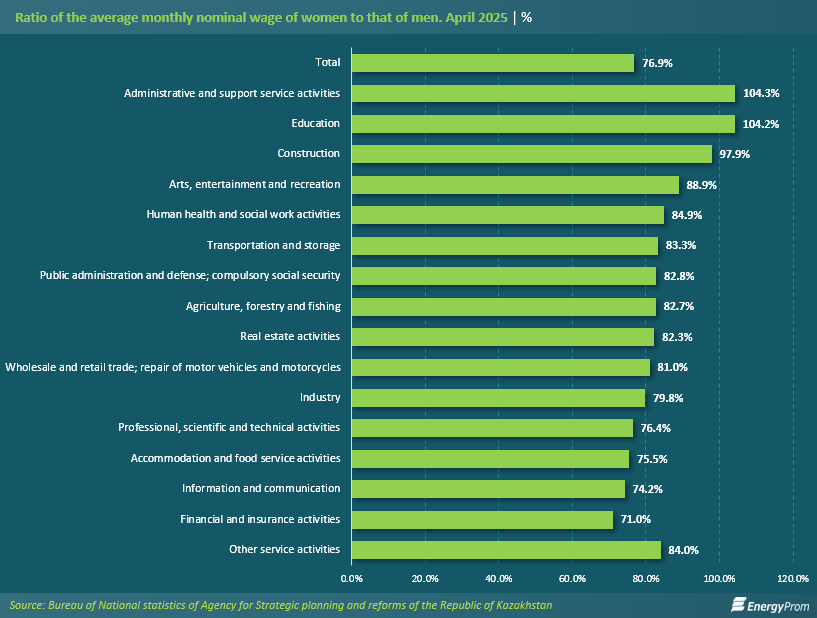
Across economic activities, only two sectors recorded average monthly nominal wages for women exceeding those of men: administrative and support services (104.3%) and education (104.2%). Near parity was observed in construction, where the ratio reached 97.9%.
At the same time, the gap remained significant in high-paying, capital-intensive industries. In financial and insurance activities, women earned only 71% of men’s wages; in information and communication — 74.2%; and in industry — 79.8%. These sectors are traditionally characterized by a higher concentration of male employment and, consequently, more pronounced gender pay disparities.
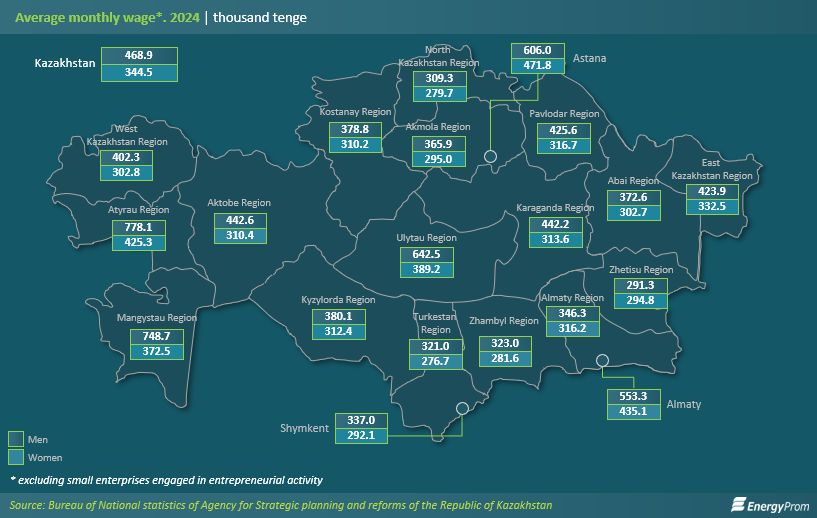
A similar pattern is observed when analyzing absolute wage levels*. By the end of 2024, men earned an average of 468.9 thousand tenge, compared to 344.5 thousand tenge for women, corresponding to a gap of 26.5%. The most significant disparity was recorded in Mangystau Region, where women’s wages were twice as low as men’s: 372.5 thousand tenge versus 748.7 thousand tenge. In Atyrau Region, women earned 45.3% less than men, and in Ulytau Region — 39.4% less. Notably, these regions also demonstrate some of the highest wage levels in the country. Thus, higher nominal wages are accompanied by more pronounced gender inequality.
In some regions, the situation appears more balanced. For example, in Zhetysu Region, women slightly outpaced men in wages by 1.2%: 294.8 thousand tenge versus 291.3 thousand tenge, respectively. A relatively small gap was also observed in Almaty Region (minus 8.7%) and North Kazakhstan Region (minus 9.6%). However, such cases are rather exceptions and do not alter the overall picture.
Overall, the gender pay gap in Kazakhstan is structural in nature and largely determined by sectoral and regional specifics of the economy. More significant disparities are observed in regions with a developed resource sector and in high-income industries, while in socially oriented sectors and agrarian regions the gap is less pronounced. Without systemic changes in the structure of employment and access to high-paying positions, a sustained reduction in gender inequality remains unlikely.
* excluding small enterprises engaged in entrepreneurial activity


Which Social Networks and Messengers Do Kazakhstan’s Young People Prefer?
9 October 2025
17834
Kazakhstan’s Citizens Are Meat Lovers: Meat and Meat Product Consumption Up by 2%
29 October 2025
10190
Gas Production Declined, While Prices Jumped 28% Year-on-Year
17 September 2025
7859
Which Social Networks and Messengers Do Kazakhstan’s Young People Prefer?
9 October 2025
17834
Kazakhstan’s Citizens Are Meat Lovers: Meat and Meat Product Consumption Up by 2%
29 October 2025
10190
Gas Production Declined, While Prices Jumped 28% Year-on-Year
17 September 2025
7859
Popular articles
Watch all

Which Social Networks and Messengers Do Kazakhstan’s Young People Prefer?
According to the analytical report “Youth of Kazakhstan” for 2024, one of the most common ways young people spend their Читать далее...
9 October 2025
17834

Kazakhstan’s Citizens Are Meat Lovers: Meat and Meat Product Consumption Up by 2%
In January–September of the current year, Kazakhstan produced 57.3 thousand tonnes of fresh or chilled meat from cattle, pigs, sheep, Читать далее...
29 October 2025
10190

Global Peace Index: The Number of Conflicts Is Rising, and the World Is Becoming More Dangerous
According to the annual Global Peace Index (GPI) published by the Institute for Economics & Peace, Iceland has remained the Читать далее...
12 January 2026
8579

Gas Production Declined, While Prices Jumped 28% Year-on-Year
In January–July of this year, natural gas production in Kazakhstan amounted to 14.8 billion cubic meters, down 10.3% compared with Читать далее...
17 September 2025
7859

Electric Vehicles Accounted for Less Than 1% of All Registered Cars in Kazakhstan
From January to July of this year, 925.8 thousand passenger cars were registered in Kazakhstan, 0.3% more than in the Читать далее...
28 August 2025
5577

“Pirating” in Kazakhstan: 59% of Young People Use Free Platforms to Watch Films and Series
According to the analytical report Youth of Kazakhstan for 2024, one of the most common leisure activities among young people Читать далее...
26 September 2025
5172

Who and why does Kazakhstan’s saiga antelope give trouble?
Experts question the department’s statistics, as well as decisions made at state level regarding saigas In early summer, there Читать далее...
28 June 2022
4811

Mobile Internet in Kazakhstan Keeps Getting Worse: Country Drops Six Places in Global Ranking
According to Ookla, the global median mobile internet speed stood at 113.16 Mbps in May 2026. The UAE topped the Читать далее...
16 July 2026
3637

Power generation reaches 53.7bn kWh in January-July, up by 1.7% year on year. Gas turbine power plants with a capacity of 100,000 kW worth KZT18.6bn were commissioned in the first half of the year
Electricity tariffs went up by 5.8% year on year in August
16 September 2016
2980

Kazakh oil refineries supplied 73.3% of motor fuel consumed and 97.4% of diesel fuel consumed in the country. Petrol output increased by 10.6% and production of gasoils by 3.6%
The price of the most popular octane-93 petrol increased by 16.4% year on year to KZT125 per litre in July. The price of summer diesel increased by 3.3% year on year to KZT99 per litre
15 September 2016
2925

How Much Do People in Kazakhstan Spend on Medicines?
In the second quarter of this year, household healthcare spending in Kazakhstan averaged 28.8 thousand tenge per household, 6.6% less Читать далее...
25 September 2025
2509

Kazakhstan’s Antibiotics Market Is Two-Thirds Dependent on Imports, While the Vitamins Market Is Almost Entirely Import-Dependent
Pharmaceutical production in Kazakhstan has increased significantly. In January–May 2026, output of basic pharmaceutical products and preparations reached KZT 109.5 Читать далее...
2 July 2026
2265

Three-Quarters of Kazakhstan’s Tea and Coffee Market Are Driven by Imports
Production of processed tea and coffee in Kazakhstan totaled 20.5 thousand tonnes in January–December of last year, up 18% compared Читать далее...
12 March 2026
2215

Focus on ESG: the world is confidently switching to green rails and sustainable development principles
In Kazakhstan, only some of the major backbone companies, major market players, and national development institutions are ready to implement Читать далее...
5 November 2021
2105

Industrial enterprises navigate to sustainable development
Major industrial companies’ investments into social and infrastructure projects in 2019 exceeded 140 billion Tenge Kazakhstan has been holding Читать далее...
5 November 2021
2023