
Kazakhstan’s Antibiotics Market Is Two-Thirds Dependent on Imports, While the Vitamins Market Is Almost Entirely Import-Dependent
2 July 2026
 2385
2385

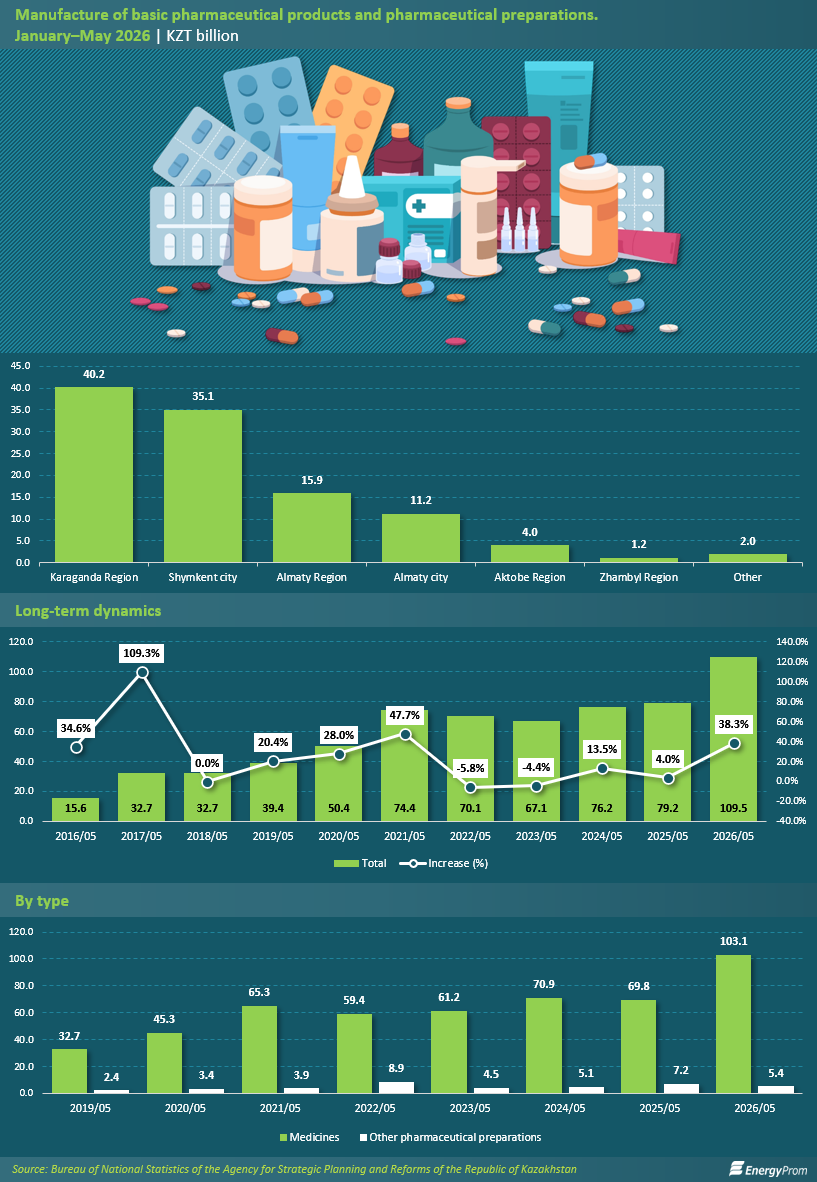
Pharmaceutical production in Kazakhstan has increased significantly. In January–May 2026, output of basic pharmaceutical products and preparations reached KZT 109.5 billion, up 38.3% from the same period last year, with the industrial production index (IPI) at 126.6%. By comparison, output stood at KZT 15.6 billion in January–May 2016, KZT 50.4 billion in 2020 and KZT 79.2 billion in 2025.
By region, pharmaceutical production remains concentrated in several key centers. Karaganda Region accounted for the largest output in January–May 2026, at KZT 40.2 billion, up 2.3-fold year on year. Shymkent ranked second with KZT 35.1 billion, although production in the city declined by 7%. It was followed by Almaty Region (KZT 15.9 billion) and Almaty city (KZT 11.2 billion), where output also fell, by 31.1% and 15.8%, respectively. Together, Karaganda Region, Shymkent, Almaty Region and Almaty city accounted for more than 93% of Kazakhstan’s total pharmaceutical output.
Medicines account for the bulk of pharmaceutical production. In January–May 2026, their output reached KZT 103.1 billion, up 47.7% year on year. By comparison, production of other pharmaceutical preparations fell by 25.6% to KZT 5.4 billion. The industry’s overall growth this year was therefore driven primarily by medicines.
The increase in output coincided with stronger government support for the sector. Kazakhstan has 209 registered domestic manufacturers of pharmaceutical and medical products. Of these, 43 produce medicines and 166 manufacture medical devices. At the beginning of 2026, 83 long-term contracts were in effect with 31 domestic manufacturers for the supply of more than 2 thousand types of medicines and medical devices. In addition, seven investment agreements worth a total of around KZT 360 billion have been signed since December 2025. Their implementation is expected to enable production of 474 new products and create more than 1.1 thousand jobs.
At the same time, the development of domestic production is not only about output volumes, but also about how quickly medicines can be brought to market. According to Kazakhstan’s Ministry of Healthcare, in February 2026 Kazakhstan became the first CIS country to achieve Maturity Level 3 for its national regulatory system for medical products, as assessed by the WHO. The country is also implementing a pilot one-stop-shop project that has reduced registration procedures from 210 to 100 days. An accelerated registration procedure of up to 15 days has been introduced for medicines from countries with stringent regulatory standards.
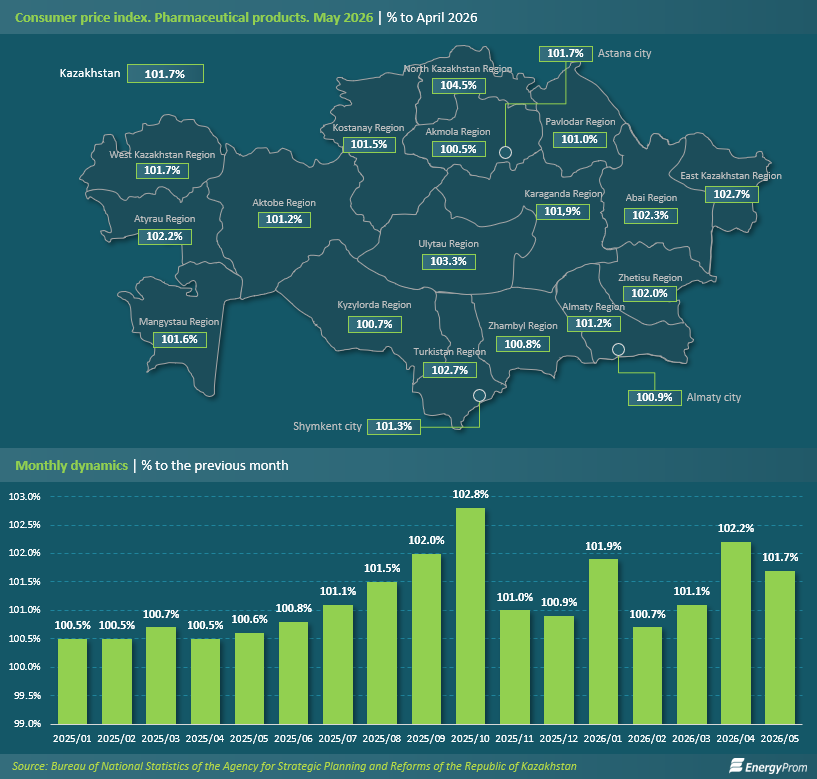
Notably, despite growing production, prices for pharmaceutical products continued to rise. In May this year, they increased by 1.7% month on month. The largest monthly increases were recorded in North Kazakhstan Region (4.5%), Ulytau Region (3.3%) and Aktobe Region (2.8%). Pharmaceutical products also rose in price faster than the national average in East Kazakhstan and Turkistan Regions, by 2.7%.
A month earlier, in April, the nationwide increase in prices was even higher, at 2.2%. The sharpest increases were recorded in Akmola Region (6.5%), Kostanay Region (6.2%) and Zhambyl Region (4.6%). Meanwhile, prices declined in Shymkent, as well as in East Kazakhstan and Atyrau Regions.
Looking at monthly trends, the acceleration became evident in the second half of last year. At the beginning of 2025, monthly price growth remained within 0.5%–0.7%, but accelerated to 2% by September and 2.8% by October. Price growth also remained substantial in 2026: prices increased by 1.9% in January, 2.2% in April and 1.7% in May.
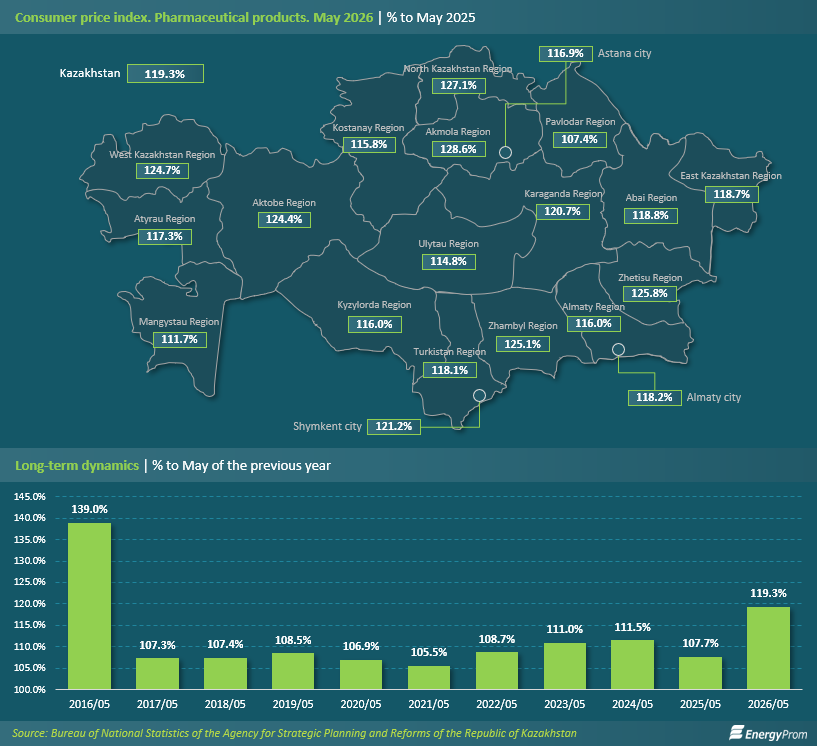
Year on year, pharmaceutical products rose in price by 19.3%. This was the highest May increase in recent years, with the exception of 2016, when prices in the sector surged by 39%. The largest increases were recorded in Akmola Region (28.6%), North Kazakhstan Region (27.1%), Zhetisu Region (25.8%), Zhambyl Region (25.1%) and West Kazakhstan Region (24.7%), while the smallest were seen in Pavlodar Region (7.4%), Mangystau Region (11.7%) and Ulytau Region (14.8%).
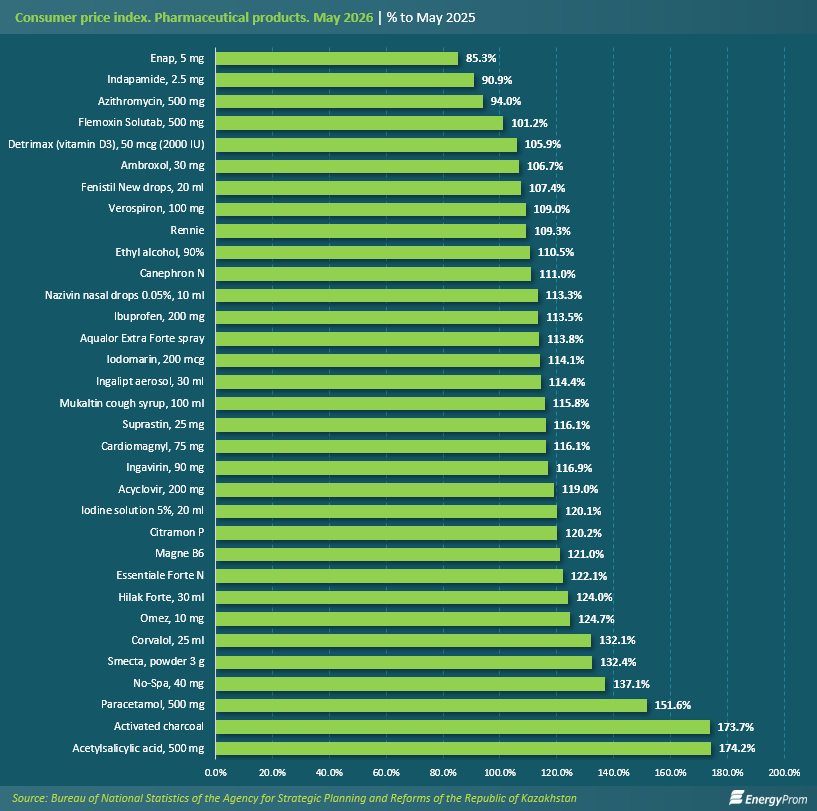
Price trends varied considerably across individual medicines. The sharpest year-on-year increases were recorded for acetylsalicylic acid (74.2%), activated charcoal (73.7%), paracetamol (51.6%), No-Spa (37.1%), Smecta (32.4%) and Corvalol (32.1%). Prices also rose significantly for Omez (24.7%), Hilak Forte (24%), Essentiale Forte N (22.1%), Magne B6 (21%) and Citramon P (20.2%). At the same time, some medicines became cheaper: Enap by 14.7%, indapamide by 9.1% and azithromycin by 6%.
These trends come amid changes to pharmaceutical price regulation. According to the government, prices for more than 5 thousand items covered by long-term contracts were recalculated, with new prices introduced in July last year. In 2025, procurement by the single distributor generated around KZT 75 billion in budget savings. Price deregulation is also continuing: it has already covered around 2.5 thousand over-the-counter medicines, while an agreement has been reached on a further 1.8 thousand prescription medicines priced at up to one monthly calculation index (MCI). According to an analysis by the Medical and Pharmaceutical Control Committee of Kazakhstan’s Ministry of Healthcare, prices declined for 631 items in the first quarter of this year, by an average of 24.6%.
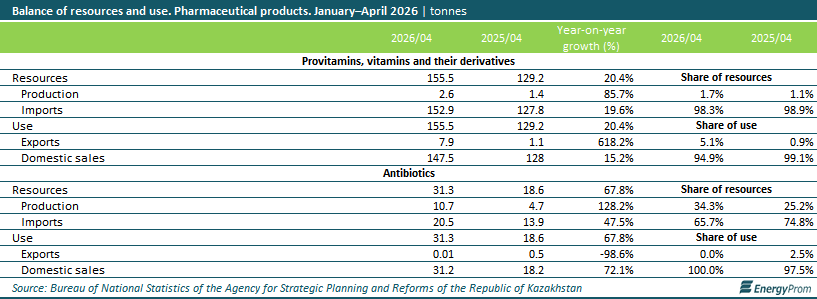
At the same time, growth in domestic production has yet to resolve Kazakhstan’s dependence on imports for certain types of pharmaceutical products. For provitamins, vitamins and their derivatives, domestic producers met just 1.7% of demand — domestic sales plus exports — in January–April 2026, compared with 1.1% in the same period last year. Domestic production increased by 85.7%, but reached only 2.6 tonnes, while imports rose by 19.6% to 152.9 tonnes. Exports increased 7.2-fold to 7.9 tonnes, while domestic sales grew by 15.2% to 147.5 tonnes.
The situation with antibiotics is more balanced, although imports also remain significant. Kazakhstan’s producers met 34.3% of demand this year, compared with 25.2% a year earlier. Output increased 2.3-fold to 10.7 tonnes in January–April 2026, while imports rose by 47.5% to 20.5 tonnes. Almost the entire volume of antibiotics was sold on the domestic market: sales reached 31.2 tonnes, up 72.1%. Exports fell from 465.3 kg to 6.3 kg.
Dependence on external supplies extends beyond finished products to raw materials. Kazakhstan’s Ministry of Healthcare previously proposed exempting imported raw materials used in pharmaceutical production from VAT under the guaranteed volume of free medical care and mandatory social health insurance.
The problem of questionable sales channels persists. In 2025, 161 criminal cases were opened over violations involving the sale and storage of unregistered medicines and medical devices, compared with 51 cases a year earlier. More than 20 thousand packages of various medicines were seized from illegal circulation last year. There were also reports of antibiotics suspected of being counterfeit: the questionable batches were seized, and administrative proceedings were initiated over the identified violations.
For the pharmaceutical industry, the next stage will be more challenging than simply increasing output. The key question is whether localization can expand from individual products to a broader range of widely used medicines. Without this, pharmaceutical production will remain an important industrial indicator, but its impact on households’ everyday spending will be limited.


Which Social Networks and Messengers Do Kazakhstan’s Young People Prefer?
9 October 2025
18186
Kazakhstan’s Citizens Are Meat Lovers: Meat and Meat Product Consumption Up by 2%
29 October 2025
10274
Gas Production Declined, While Prices Jumped 28% Year-on-Year
17 September 2025
7933
Which Social Networks and Messengers Do Kazakhstan’s Young People Prefer?
9 October 2025
18186
Kazakhstan’s Citizens Are Meat Lovers: Meat and Meat Product Consumption Up by 2%
29 October 2025
10274
Gas Production Declined, While Prices Jumped 28% Year-on-Year
17 September 2025
7933
Popular articles
Watch all

Which Social Networks and Messengers Do Kazakhstan’s Young People Prefer?
According to the analytical report “Youth of Kazakhstan” for 2024, one of the most common ways young people spend their Читать далее...
9 October 2025
18186
Kazakhstan’s Citizens Are Meat Lovers: Meat and Meat Product Consumption Up by 2%
In January–September of the current year, Kazakhstan produced 57.3 thousand tonnes of fresh or chilled meat from cattle, pigs, sheep, Читать далее...
29 October 2025
10274

Global Peace Index: The Number of Conflicts Is Rising, and the World Is Becoming More Dangerous
According to the annual Global Peace Index (GPI) published by the Institute for Economics & Peace, Iceland has remained the Читать далее...
12 January 2026
8687

Gas Production Declined, While Prices Jumped 28% Year-on-Year
In January–July of this year, natural gas production in Kazakhstan amounted to 14.8 billion cubic meters, down 10.3% compared with Читать далее...
17 September 2025
7933

Electric Vehicles Accounted for Less Than 1% of All Registered Cars in Kazakhstan
From January to July of this year, 925.8 thousand passenger cars were registered in Kazakhstan, 0.3% more than in the Читать далее...
28 August 2025
5653

“Pirating” in Kazakhstan: 59% of Young People Use Free Platforms to Watch Films and Series
According to the analytical report Youth of Kazakhstan for 2024, one of the most common leisure activities among young people Читать далее...
26 September 2025
5324
Who and why does Kazakhstan’s saiga antelope give trouble?
Experts question the department’s statistics, as well as decisions made at state level regarding saigas In early summer, there Читать далее...
28 June 2022
4875

Mobile Internet in Kazakhstan Keeps Getting Worse: Country Drops Six Places in Global Ranking
According to Ookla, the global median mobile internet speed stood at 113.16 Mbps in May 2026. The UAE topped the Читать далее...
16 July 2026
3725

Power generation reaches 53.7bn kWh in January-July, up by 1.7% year on year. Gas turbine power plants with a capacity of 100,000 kW worth KZT18.6bn were commissioned in the first half of the year
Electricity tariffs went up by 5.8% year on year in August
16 September 2016
3056

Kazakh oil refineries supplied 73.3% of motor fuel consumed and 97.4% of diesel fuel consumed in the country. Petrol output increased by 10.6% and production of gasoils by 3.6%
The price of the most popular octane-93 petrol increased by 16.4% year on year to KZT125 per litre in July. The price of summer diesel increased by 3.3% year on year to KZT99 per litre
15 September 2016
2994

How Much Do People in Kazakhstan Spend on Medicines?
In the second quarter of this year, household healthcare spending in Kazakhstan averaged 28.8 thousand tenge per household, 6.6% less Читать далее...
25 September 2025
2571

Kazakhstan’s Antibiotics Market Is Two-Thirds Dependent on Imports, While the Vitamins Market Is Almost Entirely Import-Dependent
Pharmaceutical production in Kazakhstan has increased significantly. In January–May 2026, output of basic pharmaceutical products and preparations reached KZT 109.5 Читать далее...
2 July 2026
2385

Three-Quarters of Kazakhstan’s Tea and Coffee Market Are Driven by Imports
Production of processed tea and coffee in Kazakhstan totaled 20.5 thousand tonnes in January–December of last year, up 18% compared Читать далее...
12 March 2026
2299

Focus on ESG: the world is confidently switching to green rails and sustainable development principles
In Kazakhstan, only some of the major backbone companies, major market players, and national development institutions are ready to implement Читать далее...
5 November 2021
2167

Industrial enterprises navigate to sustainable development
Major industrial companies’ investments into social and infrastructure projects in 2019 exceeded 140 billion Tenge Kazakhstan has been holding Читать далее...
5 November 2021
2065