
Mobile Internet in Kazakhstan Keeps Getting Worse: Country Drops Six Places in Global Ranking
16 July 2026
 3705
3705

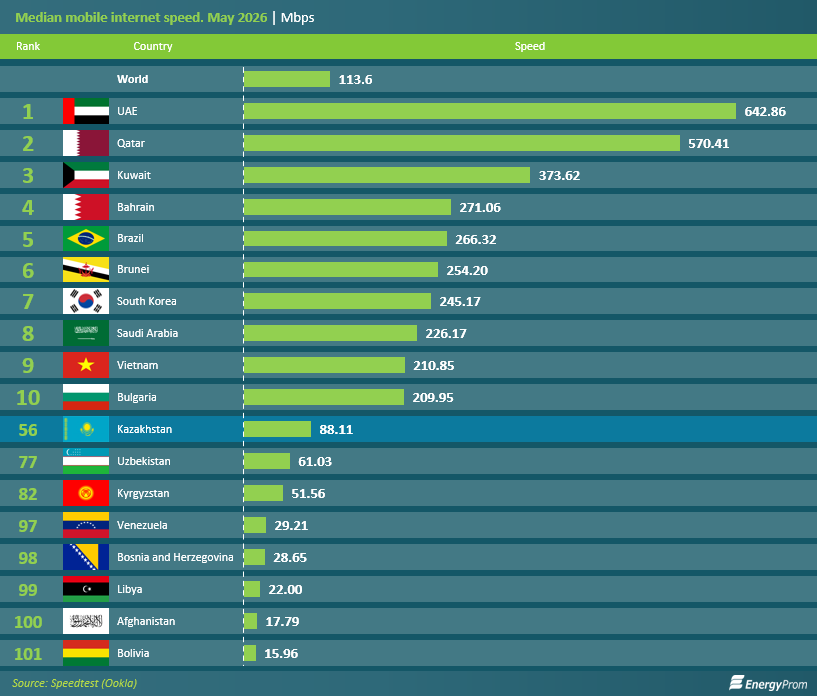
According to Ookla, the global median mobile internet speed stood at 113.16 Mbps in May 2026. The UAE topped the global ranking at 642.86 Mbps, followed by Qatar (570.41 Mbps), Kuwait (373.62 Mbps), Bahrain (271.06 Mbps) and Brazil (266.32 Mbps).
The top ten also included Brunei (254.2 Mbps), South Korea (245.17 Mbps), Saudi Arabia (226.17 Mbps), Vietnam (210.85 Mbps) and Bulgaria (209.95 Mbps). Thus, even in the country ranking tenth, the median mobile internet speed was almost twice the global average.
Kazakhstan ranked 56th out of 101 countries in May. Its median mobile internet speed stood at 88.11 Mbps — 25.05 Mbps below the global average. By comparison, Uzbekistan ranked 77th (61.03 Mbps), while Kyrgyzstan placed 82nd (51.56 Mbps).
The lowest mobile internet speed in the ranking was recorded in Bolivia, at 15.96 Mbps. It was followed by Afghanistan (17.79 Mbps), Libya (22 Mbps), Bosnia and Herzegovina (28.65 Mbps) and Venezuela (29.21 Mbps).
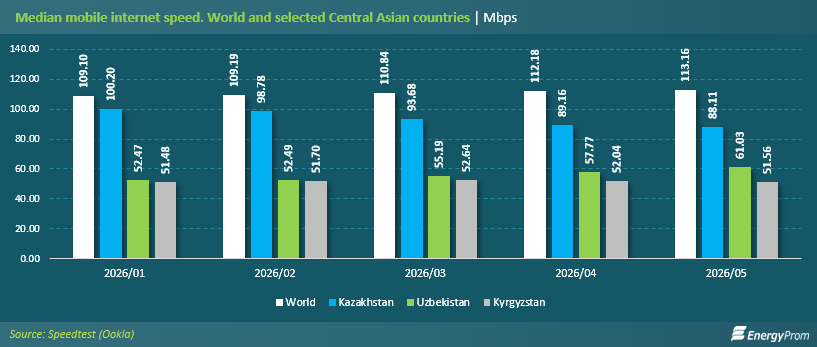
Meanwhile, mobile internet speeds in Kazakhstan have been declining. They stood at 100.2 Mbps in January 2026, fell to 89.16 Mbps in April and declined further to 88.11 Mbps in May. Since January, the figure has decreased by 12.1%, including a 1.2% drop over the past month.
The global trend moved in the opposite direction. The global median mobile internet speed increased from 109.1 Mbps in January to 112.18 Mbps in April and 113.16 Mbps in May. Since January, the figure has risen by 3.7%, including a 0.9% increase over the past month.
Against this backdrop, Kazakhstan continues to fall further behind the global level. The gap stood at 8.9 Mbps in January, 10.41 Mbps in February, 17.16 Mbps in March, 23.02 Mbps in April and 25.05 Mbps in May. While mobile internet speeds were increasing globally, the situation in Kazakhstan was deteriorating. At the same time, the country was losing ground in the ranking. Kazakhstan ranked 50th in January, 49th in February, 51st in March, 52nd in April and 56th in May. The country dropped four positions over the past month and six since January.
Kazakhstan still leads among the Central Asian countries included in the ranking, but its advantage is narrowing. In Uzbekistan, the median mobile internet speed increased from 52.47 Mbps in January to 57.77 Mbps in April and 61.03 Mbps in May. Since January, the figure has risen by 16.3%, including a 5.6% increase over the past month. As a result, Kazakhstan’s lead over Uzbekistan narrowed from 47.73 Mbps in January to 31.39 Mbps in April and 27.08 Mbps in May.
In Kyrgyzstan, the median mobile internet speed has remained almost unchanged since January: 51.48 Mbps in January, 52.04 Mbps in April and 51.56 Mbps in May. The figure declined by 0.9% over the past month but remained virtually unchanged from January.
The neighboring countries also lost ground in the global ranking. Uzbekistan slipped from 76th place in January to 77th in May, while Kyrgyzstan fell from 77th to 82nd. In Uzbekistan, however, the decline in ranking came despite faster internet speeds, meaning that other countries included in the ranking were improving even faster.
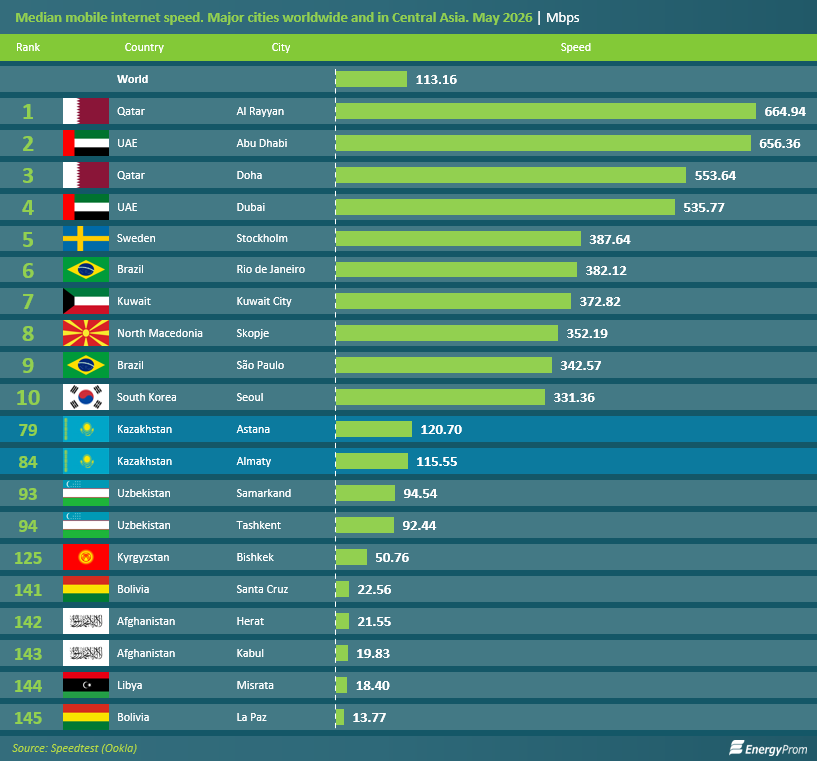
In the city ranking for May 2026, Al Rayyan (Qatar) took first place, with a median mobile internet speed of 664.94 Mbps. It was followed by Abu Dhabi (UAE) at 656.36 Mbps, Doha (Qatar) at 553.64 Mbps, Dubai (UAE) at 535.77 Mbps and Stockholm (Sweden) at 387.64 Mbps.
The top ten also included Rio de Janeiro (Brazil) at 382.12 Mbps, Kuwait City (Kuwait) at 372.82 Mbps, Skopje (North Macedonia) at 352.19 Mbps, São Paulo (Brazil) at 342.57 Mbps and Seoul (South Korea) at 331.36 Mbps.
Among the Central Asian cities included in the ranking, Astana ranked highest. Kazakhstan’s capital placed 79th, with a median mobile internet speed of 120.7 Mbps. Almaty ranked 84th at 115.55 Mbps. Both cities recorded speeds above the global average of 113.16 Mbps.
Samarkand ranked 93rd (94.54 Mbps), while Tashkent placed 94th (92.44 Mbps). Bishkek ranked 125th, with a median mobile internet speed of 50.76 Mbps.
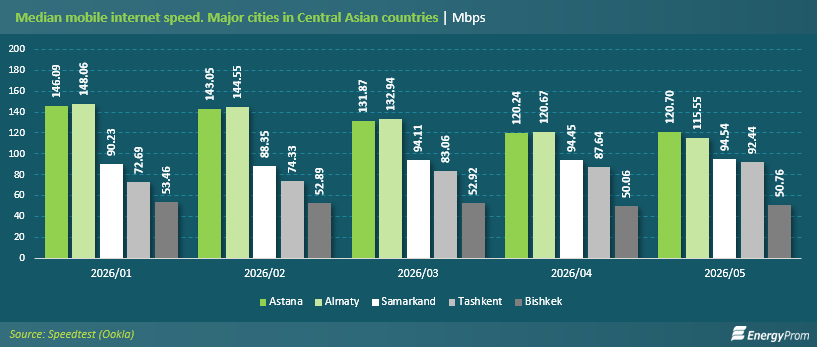
Since the beginning of the year, median mobile internet speeds in Kazakhstan’s largest cities have declined significantly. In Almaty, the figure fell from 148.06 Mbps in January to 120.67 Mbps in April and 115.55 Mbps in May. Since January, the speed has declined by 22%, including a 4.2% drop over the past month. At the same time, Almaty rapidly lost ground in the global city ranking. It ranked 60th in January, 77th in April and 84th in May. Since January, Almaty has fallen 24 positions, including 7 over the past month.
In Astana, the median mobile internet speed fell from 146.09 Mbps in January to 120.24 Mbps in April. In May, the figure edged up to 120.7 Mbps, an increase of 0.4% over the month. However, the speed has declined by 17.4% since January. The slight increase over the past month did not help the capital improve its ranking: Astana ranked 62nd in January, 78th in April and 79th in May. Since January, the city has lost 17 positions, including 1 over the past month.
Against the backdrop of deteriorating performance in Kazakhstan’s two capitals, Tashkent recorded significant gains. The median mobile internet speed increased from 72.69 Mbps in January to 87.64 Mbps in April and 92.44 Mbps in May. Since January, the figure has risen by 27.2%, including a 5.5% increase over the past month. The Uzbek capital also improved its position in the ranking. Tashkent ranked 102nd in January, 96th in April and 94th in May. Since January, the city has climbed 8 positions, including 2 over the past month.
In Samarkand, the speed increased from 90.23 Mbps in January to 94.45 Mbps in April and 94.54 Mbps in May. Since January, the figure has risen by 4.8%, while remaining virtually unchanged over the past month. At the same time, the city moved from 88th place in January to 93rd in May: the increase in speed was not enough to maintain its previous position.
In Bishkek, the median mobile internet speed fell from 53.46 Mbps in January to 50.06 Mbps in April before rising to 50.76 Mbps in May. Over the past month, the figure increased by 1.4%, but it remained 5.1% below its January level. Bishkek’s position deteriorated from 122nd place in January to 125th in May.
The lead of Kazakhstan’s two largest cities over the Uzbek capital is narrowing rapidly. In January, Astana was 73.4 Mbps ahead of Tashkent, but by May the gap had narrowed to just 28.26 Mbps. Over the same period, the difference in median mobile internet speed between Almaty and Tashkent shrank from 75.37 Mbps to 23.11 Mbps.
Kazakhstan’s deteriorating performance cannot be explained solely by its vast territory and the need to provide mobile connectivity to remote settlements. Brazil is larger than Kazakhstan by land area, yet ranked fifth globally for median mobile internet speed in May. Two Brazilian cities also made the global top ten. Against this backdrop, the decline in speeds in Almaty and Astana cannot be attributed solely to geography either, as these are the country’s two largest cities.
The main concern for Kazakhstan’s telecommunications market is not so much the country’s position in the ranking as the direction of the trend. Kazakhstan still outperforms its neighbors, but at the same time is falling further behind the global level, while its lead over Uzbekistan is narrowing rapidly. If this trend continues, Kazakhstan risks shifting from regional leader to a catch-up position: faster speeds will be needed not only to close the gap with global levels, but also to maintain its lead in Central Asia.


Which Social Networks and Messengers Do Kazakhstan’s Young People Prefer?
9 October 2025
18103
Kazakhstan’s Citizens Are Meat Lovers: Meat and Meat Product Consumption Up by 2%
29 October 2025
10257
Gas Production Declined, While Prices Jumped 28% Year-on-Year
17 September 2025
7915
Which Social Networks and Messengers Do Kazakhstan’s Young People Prefer?
9 October 2025
18103
Kazakhstan’s Citizens Are Meat Lovers: Meat and Meat Product Consumption Up by 2%
29 October 2025
10257
Gas Production Declined, While Prices Jumped 28% Year-on-Year
17 September 2025
7915
Popular articles
Watch all

Which Social Networks and Messengers Do Kazakhstan’s Young People Prefer?
According to the analytical report “Youth of Kazakhstan” for 2024, one of the most common ways young people spend their Читать далее...
9 October 2025
18103

Kazakhstan’s Citizens Are Meat Lovers: Meat and Meat Product Consumption Up by 2%
In January–September of the current year, Kazakhstan produced 57.3 thousand tonnes of fresh or chilled meat from cattle, pigs, sheep, Читать далее...
29 October 2025
10257

Global Peace Index: The Number of Conflicts Is Rising, and the World Is Becoming More Dangerous
According to the annual Global Peace Index (GPI) published by the Institute for Economics & Peace, Iceland has remained the Читать далее...
12 January 2026
8661

Gas Production Declined, While Prices Jumped 28% Year-on-Year
In January–July of this year, natural gas production in Kazakhstan amounted to 14.8 billion cubic meters, down 10.3% compared with Читать далее...
17 September 2025
7915

Electric Vehicles Accounted for Less Than 1% of All Registered Cars in Kazakhstan
From January to July of this year, 925.8 thousand passenger cars were registered in Kazakhstan, 0.3% more than in the Читать далее...
28 August 2025
5633

“Pirating” in Kazakhstan: 59% of Young People Use Free Platforms to Watch Films and Series
According to the analytical report Youth of Kazakhstan for 2024, one of the most common leisure activities among young people Читать далее...
26 September 2025
5270

Who and why does Kazakhstan’s saiga antelope give trouble?
Experts question the department’s statistics, as well as decisions made at state level regarding saigas In early summer, there Читать далее...
28 June 2022
4861

Mobile Internet in Kazakhstan Keeps Getting Worse: Country Drops Six Places in Global Ranking
According to Ookla, the global median mobile internet speed stood at 113.16 Mbps in May 2026. The UAE topped the Читать далее...
16 July 2026
3705

Power generation reaches 53.7bn kWh in January-July, up by 1.7% year on year. Gas turbine power plants with a capacity of 100,000 kW worth KZT18.6bn were commissioned in the first half of the year
Electricity tariffs went up by 5.8% year on year in August
16 September 2016
3036

Kazakh oil refineries supplied 73.3% of motor fuel consumed and 97.4% of diesel fuel consumed in the country. Petrol output increased by 10.6% and production of gasoils by 3.6%
The price of the most popular octane-93 petrol increased by 16.4% year on year to KZT125 per litre in July. The price of summer diesel increased by 3.3% year on year to KZT99 per litre
15 September 2016
2974

How Much Do People in Kazakhstan Spend on Medicines?
In the second quarter of this year, household healthcare spending in Kazakhstan averaged 28.8 thousand tenge per household, 6.6% less Читать далее...
25 September 2025
2548

Kazakhstan’s Antibiotics Market Is Two-Thirds Dependent on Imports, While the Vitamins Market Is Almost Entirely Import-Dependent
Pharmaceutical production in Kazakhstan has increased significantly. In January–May 2026, output of basic pharmaceutical products and preparations reached KZT 109.5 Читать далее...
2 July 2026
2358

Three-Quarters of Kazakhstan’s Tea and Coffee Market Are Driven by Imports
Production of processed tea and coffee in Kazakhstan totaled 20.5 thousand tonnes in January–December of last year, up 18% compared Читать далее...
12 March 2026
2278

Focus on ESG: the world is confidently switching to green rails and sustainable development principles
In Kazakhstan, only some of the major backbone companies, major market players, and national development institutions are ready to implement Читать далее...
5 November 2021
2152

Industrial enterprises navigate to sustainable development
Major industrial companies’ investments into social and infrastructure projects in 2019 exceeded 140 billion Tenge Kazakhstan has been holding Читать далее...
5 November 2021
2050