
Do Almaty Residents Really Spend 16 Times More on Retail Than Residents of Turkistan Region?
6 August 2026
 394

Examining What Is Wrong With the Official Trade Data
In the first half of 2026, Kazakhstan’s total trade turnover reached KZT 36.2 trillion, while real growth in physical volume stood at 5.7%.
Wholesale trade made the largest contribution, with turnover rising by 6.6% in real terms to KZT 24.5 trillion. Non-food goods and products for industrial and technical purposes accounted for 79.5% of wholesale turnover. The largest wholesale trade centers were Almaty city (35.2% of the nationwide total), Atyrau Region (14.9%), Astana city (14.3%) and Karaganda Region (5.5%).
Retail trade turnover, meanwhile, reached KZT 11.5 trillion in the first half of the year, up 3.8% compared with January–June 2025. Sales through retail enterprises increased by 0.8%, while turnover of individual entrepreneurs, including market trade, rose by 5.1%.
Non-food goods dominated the structure of retail turnover, accounting for 67.7%, while food products represented 32.3%. Sales of food products increased by 9.5% compared with the same period last year, while sales of non-food goods rose by 1.3%.
Almaty city traditionally accounted for the largest volume of retail trade, with a 31.5% share of the nationwide total. It was followed by Astana city (13.7%), Karaganda Region (7.1%) and East Kazakhstan Region (5.6%).
As of July 1, 2026, inventories held by reporting retail enterprises nationwide amounted to KZT 1.7 trillion, equivalent to 61 days of trade.
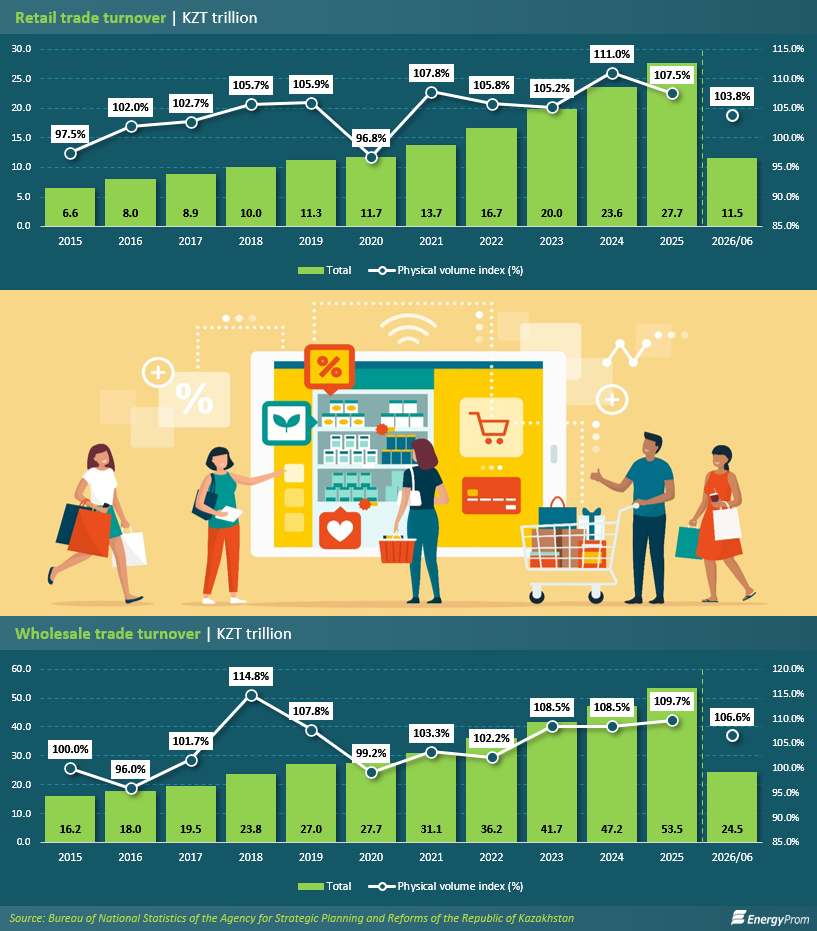
However, the official trade statistics warrant some scrutiny. The issue is most apparent in one particularly striking example. According to official data, retail trade turnover per capita in Kazakhstan amounted to KZT 1.36 million for the full year of 2025, up 16.3% in nominal terms from a year earlier.
First, let us describe the situation as it appears in the official reports. Almaty city remained the clear leader, with the figure reaching KZT 4.08 million per person — 3 times the national average. It was followed by Astana city (KZT 2.24 million) and East Kazakhstan Region (KZT 2.21 million), where retail trade turnover per capita was also significantly above the nationwide average. Karaganda Region, at KZT 1.64 million, also ranked among the top five.
Most regions were below the national average. The lowest figures were recorded in Turkistan Region (KZT 260.9 thousand per person), Zhambyl Region (KZT 496.8 thousand), Ulytau Region (KZT 553.1 thousand) and Zhetisu Region (KZT 584.1 thousand).
The highest growth rates were recorded in Akmola Region (up 32.9% in nominal terms), Turkistan Region (27.7%), West Kazakhstan Region (27.2%) and Zhetisu Region (26%). Mangystau Region was the only region where the figure declined, falling 4.3% from its 2024 level.
However, a closer look at the data makes it clear that the official statistics show an implausible degree of regional disparity. Taken at face value, the figures suggest that per capita retail spending in Shymkent is more than 4 times higher than in neighboring Turkistan Region, almost 9 times higher in Astana city, and an extraordinary 16 times higher in Almaty city.
Some of these differences can certainly be explained by objective factors. Almaty and Astana are the country’s largest retail hubs, attracting residents from other regions, with a significant share of purchases made in these major cities. Yet disparities of this magnitude, particularly between neighboring Shymkent and Turkistan Region, still appear difficult to reconcile with actual retail activity. A more plausible explanation is that the official statistics capture turnover recorded through cash-register receipts and formal reporting, while a substantial share of retail activity remains in the informal economy.


Which Social Networks and Messengers Do Kazakhstan’s Young People Prefer?
9 October 2025
18165
Kazakhstan’s Citizens Are Meat Lovers: Meat and Meat Product Consumption Up by 2%
29 October 2025
10266
Gas Production Declined, While Prices Jumped 28% Year-on-Year
17 September 2025
7925
Which Social Networks and Messengers Do Kazakhstan’s Young People Prefer?
9 October 2025
18165
Kazakhstan’s Citizens Are Meat Lovers: Meat and Meat Product Consumption Up by 2%
29 October 2025
10266
Gas Production Declined, While Prices Jumped 28% Year-on-Year
17 September 2025
7925
Popular articles
Watch all

Which Social Networks and Messengers Do Kazakhstan’s Young People Prefer?
According to the analytical report “Youth of Kazakhstan” for 2024, one of the most common ways young people spend their Читать далее...
9 October 2025
18165
Kazakhstan’s Citizens Are Meat Lovers: Meat and Meat Product Consumption Up by 2%
In January–September of the current year, Kazakhstan produced 57.3 thousand tonnes of fresh or chilled meat from cattle, pigs, sheep, Читать далее...
29 October 2025
10266

Global Peace Index: The Number of Conflicts Is Rising, and the World Is Becoming More Dangerous
According to the annual Global Peace Index (GPI) published by the Institute for Economics & Peace, Iceland has remained the Читать далее...
12 January 2026
8678

Gas Production Declined, While Prices Jumped 28% Year-on-Year
In January–July of this year, natural gas production in Kazakhstan amounted to 14.8 billion cubic meters, down 10.3% compared with Читать далее...
17 September 2025
7925

Electric Vehicles Accounted for Less Than 1% of All Registered Cars in Kazakhstan
From January to July of this year, 925.8 thousand passenger cars were registered in Kazakhstan, 0.3% more than in the Читать далее...
28 August 2025
5647

“Pirating” in Kazakhstan: 59% of Young People Use Free Platforms to Watch Films and Series
According to the analytical report Youth of Kazakhstan for 2024, one of the most common leisure activities among young people Читать далее...
26 September 2025
5311
Who and why does Kazakhstan’s saiga antelope give trouble?
Experts question the department’s statistics, as well as decisions made at state level regarding saigas In early summer, there Читать далее...
28 June 2022
4871

Mobile Internet in Kazakhstan Keeps Getting Worse: Country Drops Six Places in Global Ranking
According to Ookla, the global median mobile internet speed stood at 113.16 Mbps in May 2026. The UAE topped the Читать далее...
16 July 2026
3721

Power generation reaches 53.7bn kWh in January-July, up by 1.7% year on year. Gas turbine power plants with a capacity of 100,000 kW worth KZT18.6bn were commissioned in the first half of the year
Electricity tariffs went up by 5.8% year on year in August
16 September 2016
3050

Kazakh oil refineries supplied 73.3% of motor fuel consumed and 97.4% of diesel fuel consumed in the country. Petrol output increased by 10.6% and production of gasoils by 3.6%
The price of the most popular octane-93 petrol increased by 16.4% year on year to KZT125 per litre in July. The price of summer diesel increased by 3.3% year on year to KZT99 per litre
15 September 2016
2989

How Much Do People in Kazakhstan Spend on Medicines?
In the second quarter of this year, household healthcare spending in Kazakhstan averaged 28.8 thousand tenge per household, 6.6% less Читать далее...
25 September 2025
2565

Kazakhstan’s Antibiotics Market Is Two-Thirds Dependent on Imports, While the Vitamins Market Is Almost Entirely Import-Dependent
Pharmaceutical production in Kazakhstan has increased significantly. In January–May 2026, output of basic pharmaceutical products and preparations reached KZT 109.5 Читать далее...
2 July 2026
2376

Three-Quarters of Kazakhstan’s Tea and Coffee Market Are Driven by Imports
Production of processed tea and coffee in Kazakhstan totaled 20.5 thousand tonnes in January–December of last year, up 18% compared Читать далее...
12 March 2026
2291

Focus on ESG: the world is confidently switching to green rails and sustainable development principles
In Kazakhstan, only some of the major backbone companies, major market players, and national development institutions are ready to implement Читать далее...
5 November 2021
2163

Industrial enterprises navigate to sustainable development
Major industrial companies’ investments into social and infrastructure projects in 2019 exceeded 140 billion Tenge Kazakhstan has been holding Читать далее...
5 November 2021
2061