
How Food-Secure Are Kazakhstan and Other Central Asian Countries?
26 June 2026
 1001
1001
Food security remains one of humanity’s most pressing challenges. In the wake of the COVID-19 pandemic, amid military conflicts and disruptions to global supply chains, the issue of domestic food production has become even more critical. At the same time, achieving complete self-sufficiency even in basic food categories remains exceptionally rare.
According to a Nature Food study published in 2025 by researchers from the University of Göttingen and the University of Edinburgh, only one of the 186 countries included in the analysis — Guyana — is fully self-sufficient across all seven major food groups: fruits, vegetables, dairy products, fish, meat, legumes, nuts and seeds, and starchy staple foods (including cereals, potatoes and similar crops). Only two other countries — China and Vietnam — are self-sufficient in six of the seven categories. Both fall short only in dairy production. Domestic output meets between 40% and 60% of dairy demand in China, compared with less than 20% in Vietnam.
The next group comprises countries that are self-sufficient in five of the seven major food groups. These include Paraguay, New Zealand, Uruguay, Vanuatu, Argentina, Brazil, Lithuania, Estonia, Australia, Latvia, Spain, Serbia, Croatia, Ukraine, Peru, Türkiye, Romania, Russia, Laos, Oman, the Philippines, as well as Kazakhstan, Uzbekistan and Kyrgyzstan. This highlights that even major agricultural producers are generally unable to meet domestic demand for all key food categories through their own production alone.
At the opposite end of the spectrum are countries that are not fully self-sufficient in any of the seven food groups. These include Afghanistan, Iraq, Yemen, the United Arab Emirates, Qatar and Macao (China). The contrast illustrates that food security depends not only on production volumes, but also on the structure of agriculture, natural conditions, population size and trade links.
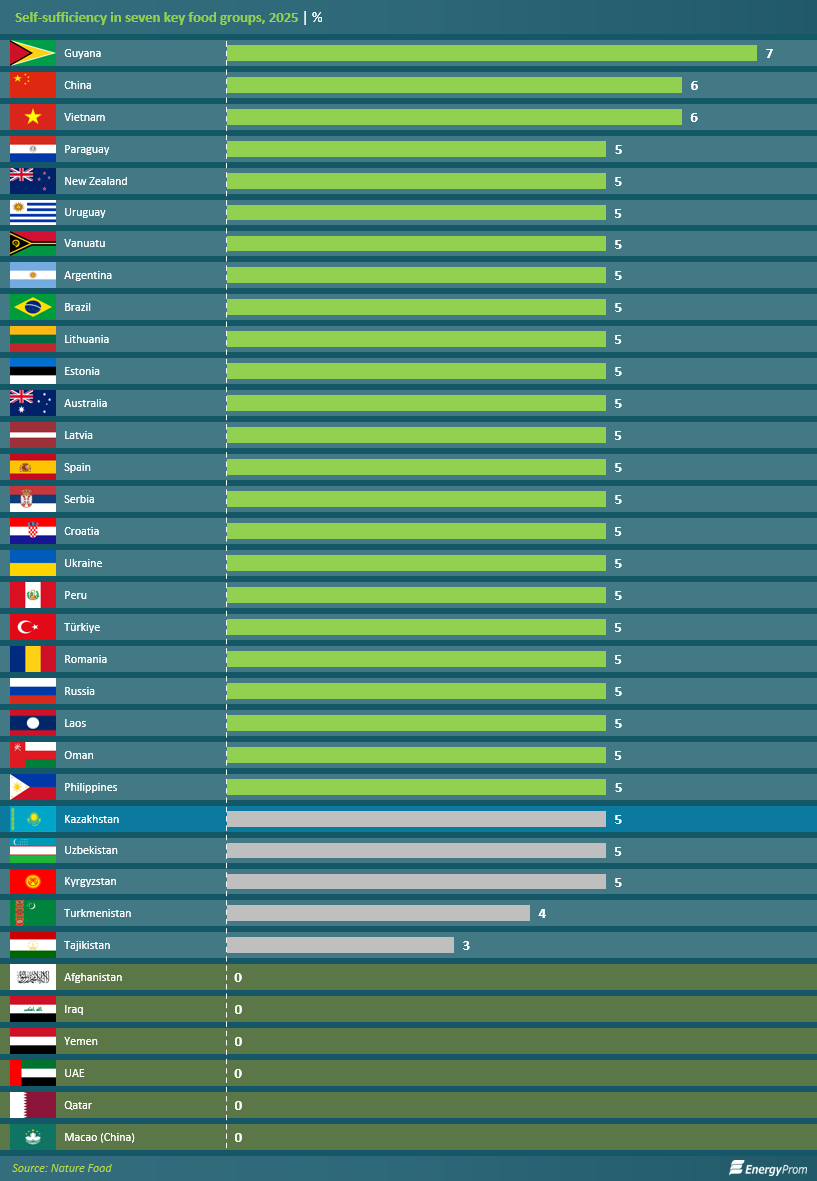
Against this backdrop, the countries of Central Asia appear relatively resilient, although not fully self-sufficient. Kazakhstan, Uzbekistan and Kyrgyzstan are self-sufficient in five major food groups, Turkmenistan in four, and Tajikistan in three. Vegetables, dairy products and meat are common strengths across the region, with every Central Asian economy achieving full self-sufficiency in these categories. Fish, meanwhile, remains the region’s shared weak spot, with domestic production meeting no more than 20% of demand in every country.
Kazakhstan is also fully self-sufficient in legumes, nuts and seeds, as well as in starchy staple foods. At the same time, self-sufficiency in fruit remains low, with domestic production covering no more than 20% of demand. Uzbekistan, meanwhile, is fully self-sufficient in fruit and starchy staple foods, while coverage for legumes, nuts and seeds stands at between 20% and 40%. Kyrgyzstan is self-sufficient in legumes, nuts and seeds, as well as in starchy staple foods. Fruit production meets between 40% and 60% of domestic demand.
In addition to the three food groups in which all Central Asian countries are fully self-sufficient, Turkmenistan also achieves full self-sufficiency in starchy staple foods. Its fruit self-sufficiency is close to complete, ranging between 80% and 100%, but still falls short of the 100% threshold. Coverage for legumes, nuts and seeds remains below 20%. Tajikistan has the fewest fully covered food groups in the region. Domestic production meets between 60% and 80% of demand for fruit and starchy staple foods, and between 40% and 60% for legumes, nuts and seeds.
When Central Asia is viewed as a region of complementary economies, the picture becomes broader: collectively, the five countries are self-sufficient in six of the seven major food groups. Fish remains the only common weak point, but strong intra-regional trade enables neighbouring countries to meet demand across all other food categories.

According to the Bureau of National Statistics of the Agency for Strategic Planning and Reforms of the Republic of Kazakhstan, the country’s food self-sufficiency remained uneven across individual food categories in January–April of this year. In the category of meat and poultry, including edible offal, domestic production covered 87.6% of demand. The figure was lower for poultry meat and edible offal, at 75.9%, with the remaining 24.1% supplied through imports. By contrast, domestic production accounted for only 4.5% of demand for fats of cattle, sheep, goats and pigs, while imports represented 95.5%.
Self-sufficiency stood at 66.7% for salted, dried or smoked meat and edible meat offal, and at 69.9% for prepared and preserved meat products. This indicates that, despite relatively strong overall performance in the meat category, Kazakhstan continues to rely on imports for a number of processed and specialised meat products.
Domestic production covered 53.7% of demand for processed and preserved fish, crustaceans and molluscs. While this is higher than the estimate for the broader fish category reported in the international study, the national data refer only to processed and preserved products.
In the dairy category, excluding fresh milk, self-sufficiency reached 86%. Eggs recorded one of the highest levels among the product groups analysed, at 96.8%. The strongest positions were observed in flour and cereal products: self-sufficiency reached 99.4% for flour, 93.5% for cereals, including rice, 85% for bakery and confectionery products, and 79.2% for pasta, noodles, couscous and similar flour-based products.
Domestic production met 64.4% of demand for fruit and vegetable juices. However, self-sufficiency amounted to just 16% for processed and preserved vegetables, excluding potatoes, and only 14% for processed and preserved fruit and nuts. These figures point to a strong reliance on imports in the segment of processed fruit and vegetable products.
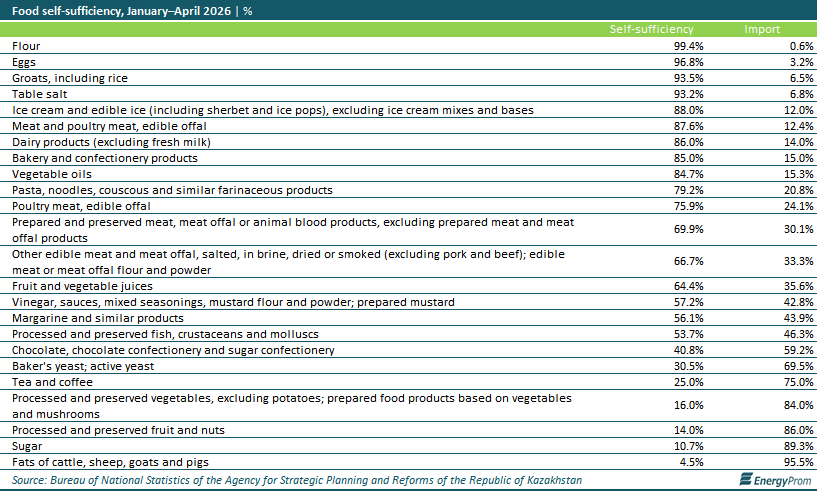
Kazakhstan is best positioned in staple food products, including grains, flour, eggs, dairy products and parts of the meat category. More vulnerable areas include processed fruit and vegetable products, sugar and animal fats. Amid increasingly fragile global supply chains, the combination of domestic production and stable trade links with neighbouring countries is particularly important for the region. Some countries have stronger positions in fruit production, others in legumes or grains, and with well-developed logistics this specialisation benefits the region as a whole.


Which Social Networks and Messengers Do Kazakhstan’s Young People Prefer?
9 October 2025
18056
Kazakhstan’s Citizens Are Meat Lovers: Meat and Meat Product Consumption Up by 2%
29 October 2025
10246
Gas Production Declined, While Prices Jumped 28% Year-on-Year
17 September 2025
7906
Which Social Networks and Messengers Do Kazakhstan’s Young People Prefer?
9 October 2025
18056
Kazakhstan’s Citizens Are Meat Lovers: Meat and Meat Product Consumption Up by 2%
29 October 2025
10246
Gas Production Declined, While Prices Jumped 28% Year-on-Year
17 September 2025
7906
Popular articles
Watch all

Which Social Networks and Messengers Do Kazakhstan’s Young People Prefer?
According to the analytical report “Youth of Kazakhstan” for 2024, one of the most common ways young people spend their Читать далее...
9 October 2025
18056
Kazakhstan’s Citizens Are Meat Lovers: Meat and Meat Product Consumption Up by 2%
In January–September of the current year, Kazakhstan produced 57.3 thousand tonnes of fresh or chilled meat from cattle, pigs, sheep, Читать далее...
29 October 2025
10246

Global Peace Index: The Number of Conflicts Is Rising, and the World Is Becoming More Dangerous
According to the annual Global Peace Index (GPI) published by the Institute for Economics & Peace, Iceland has remained the Читать далее...
12 January 2026
8647

Gas Production Declined, While Prices Jumped 28% Year-on-Year
In January–July of this year, natural gas production in Kazakhstan amounted to 14.8 billion cubic meters, down 10.3% compared with Читать далее...
17 September 2025
7906

Electric Vehicles Accounted for Less Than 1% of All Registered Cars in Kazakhstan
From January to July of this year, 925.8 thousand passenger cars were registered in Kazakhstan, 0.3% more than in the Читать далее...
28 August 2025
5622

“Pirating” in Kazakhstan: 59% of Young People Use Free Platforms to Watch Films and Series
According to the analytical report Youth of Kazakhstan for 2024, one of the most common leisure activities among young people Читать далее...
26 September 2025
5243
Who and why does Kazakhstan’s saiga antelope give trouble?
Experts question the department’s statistics, as well as decisions made at state level regarding saigas In early summer, there Читать далее...
28 June 2022
4847

Mobile Internet in Kazakhstan Keeps Getting Worse: Country Drops Six Places in Global Ranking
According to Ookla, the global median mobile internet speed stood at 113.16 Mbps in May 2026. The UAE topped the Читать далее...
16 July 2026
3696

Power generation reaches 53.7bn kWh in January-July, up by 1.7% year on year. Gas turbine power plants with a capacity of 100,000 kW worth KZT18.6bn were commissioned in the first half of the year
Electricity tariffs went up by 5.8% year on year in August
16 September 2016
3018

Kazakh oil refineries supplied 73.3% of motor fuel consumed and 97.4% of diesel fuel consumed in the country. Petrol output increased by 10.6% and production of gasoils by 3.6%
The price of the most popular octane-93 petrol increased by 16.4% year on year to KZT125 per litre in July. The price of summer diesel increased by 3.3% year on year to KZT99 per litre
15 September 2016
2965

How Much Do People in Kazakhstan Spend on Medicines?
In the second quarter of this year, household healthcare spending in Kazakhstan averaged 28.8 thousand tenge per household, 6.6% less Читать далее...
25 September 2025
2541

Kazakhstan’s Antibiotics Market Is Two-Thirds Dependent on Imports, While the Vitamins Market Is Almost Entirely Import-Dependent
Pharmaceutical production in Kazakhstan has increased significantly. In January–May 2026, output of basic pharmaceutical products and preparations reached KZT 109.5 Читать далее...
2 July 2026
2341

Three-Quarters of Kazakhstan’s Tea and Coffee Market Are Driven by Imports
Production of processed tea and coffee in Kazakhstan totaled 20.5 thousand tonnes in January–December of last year, up 18% compared Читать далее...
12 March 2026
2269

Focus on ESG: the world is confidently switching to green rails and sustainable development principles
In Kazakhstan, only some of the major backbone companies, major market players, and national development institutions are ready to implement Читать далее...
5 November 2021
2139

Industrial enterprises navigate to sustainable development
Major industrial companies’ investments into social and infrastructure projects in 2019 exceeded 140 billion Tenge Kazakhstan has been holding Читать далее...
5 November 2021
2046